Goals
- Quantify the effects of nitrogen addition on the biomass and dominance of the invasive grass Festuca arundinacea in a coastal pampean grassland.
- Assess whether biomass mowing (as an analog of herbivory) reduces the dominance of F. arundinacea and promotes the recovery of subordinate plant species.
- Evaluate the individual and interactive effects of nitrogen enrichment and biomass removal on plant species richness, diversity, and community composition.
- Determine how these drivers influence beta diversity and spatial heterogeneity among plant communities.
- Provide ecological evidence to inform grassland management strategies aimed at maintaining biodiversity under the combined pressures of biological invasion and global change.
Summary
Grassland ecosystems are globally threatened by the loss or replacement of native herbivores by livestock and by anthropogenic nutrient inputs. In the grasslands of the Mar Chiquita Nature Reserve,
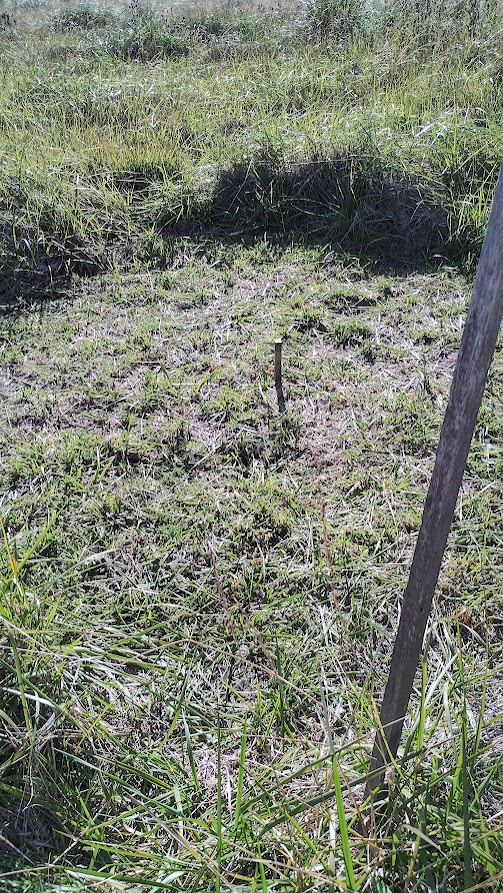
Festuca arundinacea, an invasive exotic grass, has tripled its cover over the last decade (mean = 60%), becoming the dominant species in the herbaceous community. This study evaluated the effects of nitrogen (N) addition and biomass mowing—as a proxi for herbivory—on the dominance of the exotic grass F. arundinacea and the response of subordinate herbaceous species. A factorial experiment was established using 3 × 3 m plots combining two fertilization levels (with/without N) and two biomass removal levels (with/without mowing) during 2023, 2024 and 2025. The preliminary results showed that nitrogen addition increased grass biomass, which was largely composed of F. arundinacea. In contrast, mowing significantly reduced total biomass, litter accumulation, and the dominance of the invasive species, while promoting increases in the richness and diversity of subordinate species, regardless of fertilization. Biomass mowing not only caused a marked shift in community composition but also increased variability among replicates (beta diversity). In contrast, nutrient addition promoted compositional homogenization, likely through increased dominance of F. arundinacea. These findings demonstrate the impact of an invasive species on plant community structure and highlight the key role of herbivory-related disturbance (or its mechanical replacement) as a management tool for conserving biodiversity in grasslands affected by global change.
Experimental design
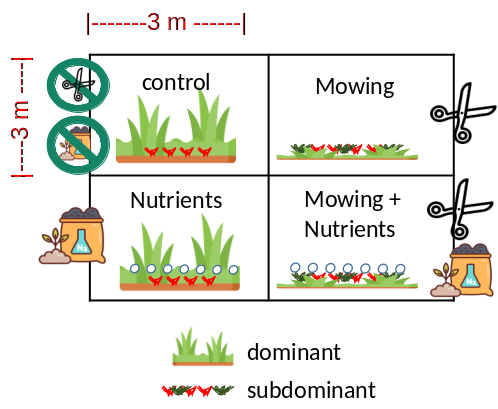
We implemented a factorial design using 3 m x 3 m replicate plots (n=6) to evaluate the individual and interactive effects of two factors: nutrient enrichment through nitrogen fertilization, and disturbance through the cutting of all plant biomass.
There were four treatments, with mowing disturbance (two levels, with/without) and N fertilizer application (two levels, with/without) as the main factors.
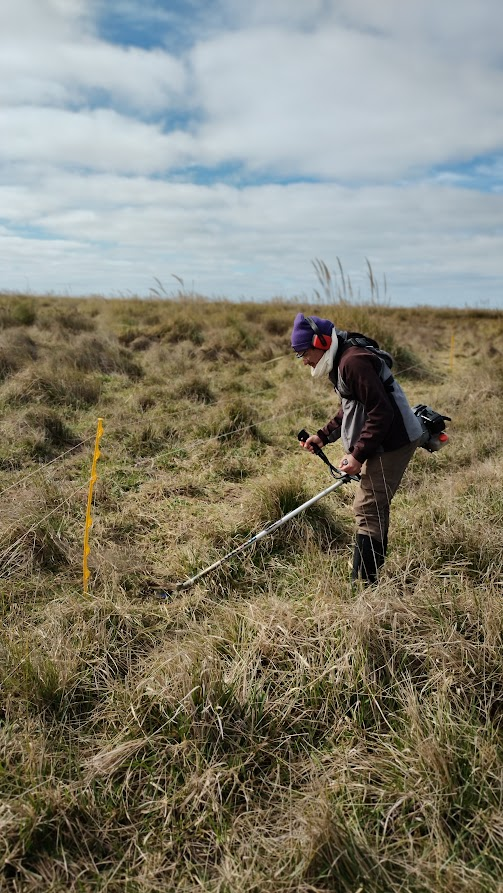
Mowing was repeated two times a year, in late summer (April) and late winter (August), simultaneously with nutrient addition. Mowing consisted of cutting all standing biomass to a height of 5 cm with a garden trimmer.
The mowing treatment was intended to increase light penetration to the soil surface, thereby simulating the canopy disturbance generated by domestic herbivores in grassland ecosystems. Nitrogen was applied as granulated ammonium nitrate at a rate of approximately 25 g N m⁻² year⁻¹ (Urea 43-0-0; 43% N; total application = 225 g urea per plot), following the protocols established by NutNet (https://nutnet.org/nutrients).