
Goals
-
- To evaluate how fertilization affects the ecological functioning of salt marshes, their associated trophic networks, and their connections with neighbouring ecosystems.
-
- To establish a long-term monitoring base data of fertilization impacts in coastal ecosystems. This will enable the development of future ecological scenarios and responses to growing anthropogenic pressures in the region.
Research questions
-
- How does increased N availability affect key ecosystem functions in salt marshes?
-
- How is the arthropod assemblage and food web structure altered by N enrichment?
-
- Does increased N influence the abundance of terrestrial organisms that use the salt marsh and, in turn, the active transfer of energy between habitats?
-
- Is energy transfer to mudflat affected by fertilization? What is the impact on benthic community structure?
-
- Does N enrichment affect carbon (C) storage capacity or C fluxes within the salt marsh?
Experimental setup
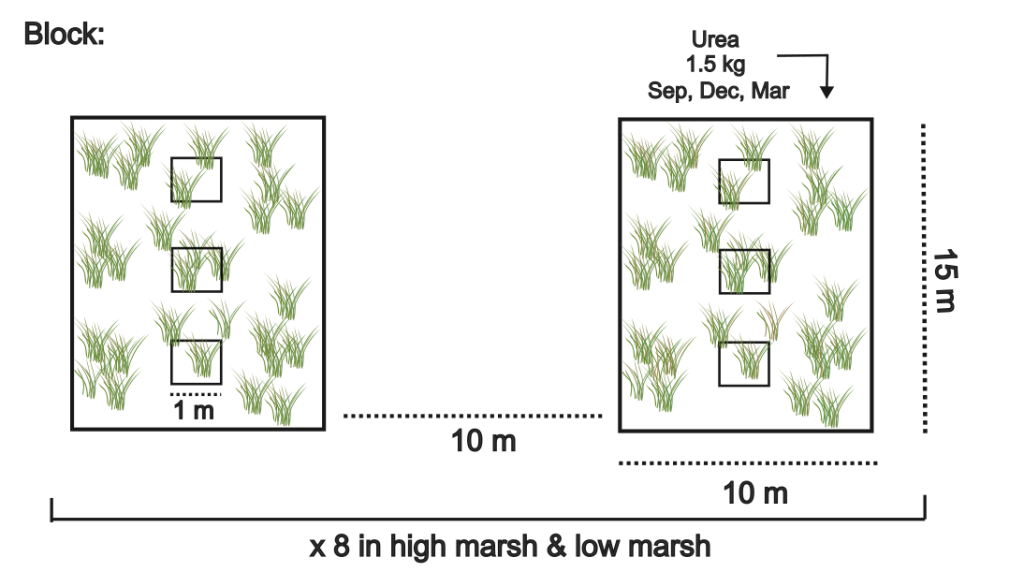
This is a long-term experimental study in salt marsh ecology. We apply an ecosystem-level approach to understand the effects of eutrophication on salt marsh ecosystems in the Mar Chiquita coastal lagoon, Buenos Aires, Argentina.
Since 2018, we have maintained 32 experimental plots (10 x 15 m each), arranged in 16 independent blocks: 8 at the saltmarsh-grassland transition and 8 at the saltmarsh-mudflat transition. Each block contains two plots separated by 10 meters: one with fertilization and one without. Fertilized plots receive 4.5 kg of solid urea per year, applied manually during low tide (1.5 kg in September, December & March). Within each plot, we define three subplots at different elevations (high, mid, and low) to measure key ecological variables.
Annually, we sample: vegetation cover and litter cover, organic matter and water content in sediment, crab burrow abundance, inorganic nutrients, and carbon concentrations in sediment and pore water. Aboveground and belowground biomass is sampled every five years.
Map
